In the WhiskyPolska catalogue, every bottle shows a TYPE column and a set of filters (type, cask, peat, cask strength, IB…). If any of these labels is a mystery to you, this article is exactly for that. Treat it as a legend: we explain every type of whisky and every label so you can filter knowingly and know what to expect on the palate.
If you're just starting out, begin with How to choose your first whisky? and How whisky is made. Here we focus on classification.
A quick legend for the TYPE column
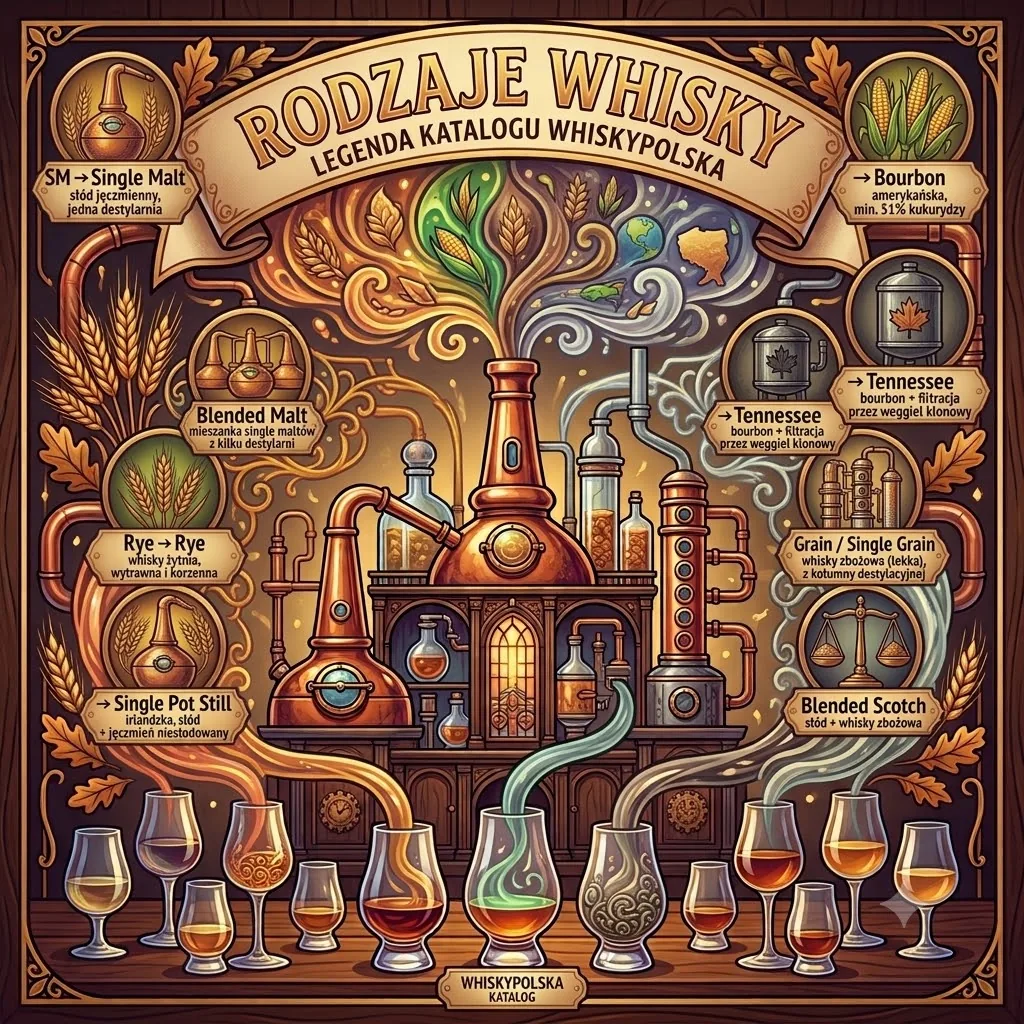
In the catalogue table, the type is abbreviated for brevity. Here are the full forms (we unpack each one below):
- SM → Single Malt — malted barley, one distillery.
- Blended Malt → Blended Malt — a blend of single malts from several distilleries.
- Blended → Blended Scotch — malt + grain whisky.
- Grain → Grain / Single Grain — grain whisky (light), from a column still.
- Bourbon → Bourbon — American, min. 51% corn.
- Tennessee → Tennessee — bourbon + charcoal mellowing (sugar maple).
- Rye → Rye — rye whisky, dry and spicy.
- Pot Still → Single Pot Still — Irish, malted + unmalted barley.
Single Malt (SM) — the foundation of the whisky world
This is the most sought-after type and the heart of the Scotch tradition. A Single Malt must meet three conditions: it is made exclusively from malted barley, at a single distillery, distilled in pot stills.
The most important linguistic trap: the word single refers to one distillery, not one cask or one type of malt. A single malt is usually a marriage of many casks — but all from the same distillery, which gives a recognisable, consistent character (e.g. fruity Glenfiddich, sherried Macallan, smoky Lagavulin).
→ Single malts in the catalogue
Blended Malt — several distilleries, malt only
Blended Malt (formerly "vatted malt" or "pure malt") is a blend of single malts from several different distilleries — but without grain whisky. The master blender marries the characters of different distilleries into one intended profile. Classics: Monkey Shoulder, Compass Box, Big Peat.
The difference from single malt is simple: single malt = one distillery, blended malt = several distilleries, but in both cases 100% malted barley.
→ Blended Malt in the catalogue
Blended — the world's most popular whisky
Blended Scotch is a combination of malt whisky with grain whisky. It's blends that account for roughly 90% of Scotch whisky sales worldwide — Johnnie Walker, Ballantine's, Chivas Regal, Grant's, Dewar's. Grain whisky brings lightness and smoothness and lowers the cost, while the malts add character and depth.
Blends are sometimes underrated, and unfairly so — a good blend can be beautifully balanced, and it's usually a gentle, approachable way into the world of whisky.
Grain / Single Grain — the light base of blends
Grain whisky is made from grains other than malted barley alone (most often wheat or corn, with some malt) and is distilled in continuous (column) stills rather than pot stills. The result: a lighter, more delicate, often more "vanilla-and-cereal" profile.
Most grain whisky goes into blends, but it's also bottled on its own — Single Grain then means grain whisky from one distillery (e.g. Haig Club, Loch Lomond Single Grain). In the table we mark both variants with the short form Grain.
Bourbon, Tennessee and Rye — America
On the other side of the Atlantic, different grains and different rules apply:
- Bourbon — the flagship American whiskey. Min. 51% corn, matured in **new, charred
oak barrels** (hence the intense vanilla, caramel, sweetness). No colouring or flavouring additives. Examples: Buffalo Trace, Maker's Mark, Woodford Reserve. → Bourbons in the catalogue
- Tennessee — in practice a bourbon, but with an extra step: **filtration through sugar
maple charcoal** (the Lincoln County Process), which softens and "smooths" the spirit. The most famous: Jack Daniel's, plus George Dickel.
- Rye — rye whisky (in the US, min. 51% rye). Rye gives a distinctly **dry, spicy,
peppery** character — completely different from sweet bourbon. Note: Canadian "rye" can be milder and not necessarily high in rye content. → Rye in the catalogue
Single Pot Still (Pot Still) — the Irish speciality
Single Pot Still is Ireland's calling card: whisky from one distillery, from a mash of malted and unmalted barley, distilled in pot stills (usually three times). The unmalted barley gives a characteristic, slightly spicy, creamy texture. Examples: Redbreast, Green Spot, Powers. In the table: Pot Still.
IB — independent bottlings
One of the most important concepts in the catalogue. You can buy whisky through two "channels":
- OB (Official Bottling) — an official bottling, released by the distillery itself
(e.g. Glenfarclas 15 released by Glenfarclas).
- IB (Independent Bottler) — an independent bottler buys casks from the distillery
and bottles them under its own brand. The best known are Gordon & MacPhail, Signatory, Douglas Laing, Cadenhead's, That Boutique-y Whisky Company.
Why does it matter? IB releases are often single cask, at cask strength, in small, numbered batches — they tend to be more unusual and unique than the distillery's official range. In the catalogue you can isolate independent bottlings only with the IB filter, and clicking a bottler's name shows all of its bottles.
Peated and unpeated — a question of smoke
This is a split by flavour, not origin. Peat is the material used to dry the malt — when the malt dries over peat smoke it absorbs phenolic compounds that give the whisky its characteristic smoky, smoked, sometimes "medicinal" or maritime aroma.
- Peated — smoke ranging from subtle to very intense. The kingdom of Islay: Ardbeg,
Laphroaig, Lagavulin, but also Talisker and peated releases from outside Islay.
- Unpeated — no smoke (or just a trace), and a full spectrum of other flavours: fruit,
honey, vanilla, sherry, spices.
Smoke intensity is measured in PPM (parts per million of phenols) — the higher the PPM, the stronger the smoke. The Peated / Unpeated filters in the catalogue let you narrow the choice to your own thing straight away.
Cask Strength — full barrel strength
Standard whisky is diluted with water before bottling, to about 40–46% ABV. Cask Strength means the whisky goes into the bottle straight from the cask, undiluted — usually in the ~50–65% ABV range.
What does it give you? More intensity, depth and aroma, plus the ability to dial in the strength yourself — adding a few drops of water "opens up" the whisky and you decide on the power. It's the choice for those who want maximum character. The Cask Strength filter gathers such bottles in one place. A related concept is single cask — whisky from one specific cask (often, though not always, bottled at cask strength).
Bonus: the "Cask" filter — where the flavour comes from
Type isn't everything — flavour is hugely determined by the cask the whisky matured in. In the catalogue you can filter by cask type:
- Bourbon — vanilla, honey, coconut, sweetness (the most common type).
- Sherry — dried fruit, raisins, chocolate, spices.
- Wine Port Rum — fruity, sweet, dessert-like finishes.
- Other — incl. brandy, cognac, calvados, tequila, beer, vermouth, Japanese mizunara.
How to put it all together
When choosing a bottle in the catalogue, combine three dimensions:
- Type (the TYPE column) — single malt, blend, bourbon, rye…
- Flavour — peated vs unpeated + cask type (bourbon/sherry/…).
- Strength and edition — standard vs cask strength, OB vs IB.
That's enough to navigate the catalogue knowingly. For more context on distilleries, brands and their history, take a look at Whiskypedia. Cheers — sensibly and 18+.