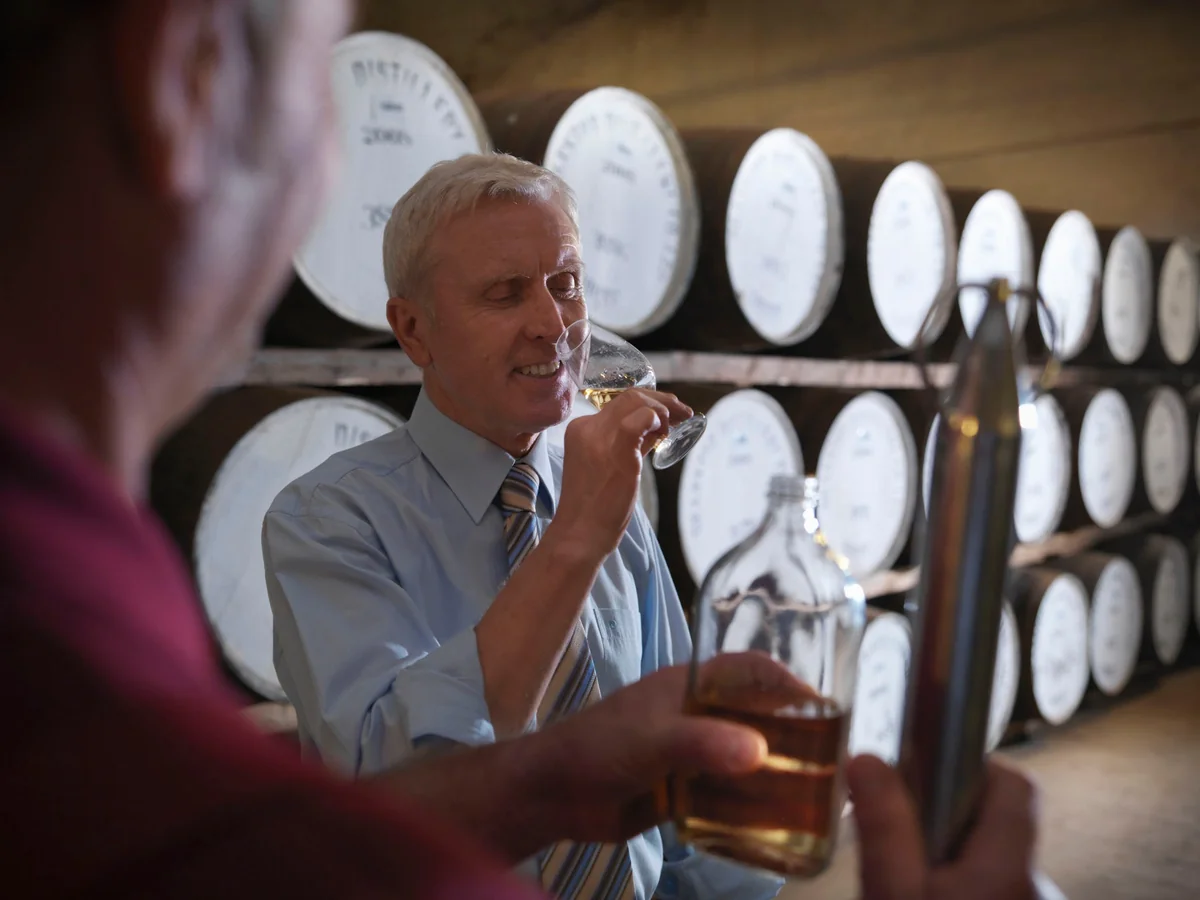
After years spent in the dark warehouse, nature's role comes to an end. The cask's fate now lies in the hands of one person — the Master Blender. It is he who decides when the oak adventure is over and how to bring together dozens, and sometimes hundreds, of unique casks into one perfectly balanced composition.
The conductor of flavour: who is the Master Blender?
Many beginners think that a bottle of their favourite single malt (e.g. the 12-year-old version) comes from one specific cask. Nothing could be further from the truth. Two identical casks filled with the same spirit and set side by side in the warehouse will, after 12 years, taste completely different.
The Master Blender's task is to keep the flagship product's profile identical year after year. To achieve this, he draws samples from hundreds of casks and, using his brilliant sense of smell, creates a unique "recipe" (the blending recipe). He is an artist who, instead of paints, mixes the aromas of vanilla, smoke, fruit and oak.
Cask finishing — the final polish
Before the whisky reaches the bottle, the Master Blender may decide on finishing — transferring the matured whisky from traditional casks (e.g. ex-bourbon) into other, exceptionally active casks for a short period, usually 6 to 24 months.
Finishing uses casks that once held rare fortified wines (Sherry Oloroso, Pedro Ximénez, Port, Madeira), rum, and even heavily peated whisky. This brief "encore" lays a new aromatic layer (raisins, dark chocolate, exotic fruit) over the base profile without overpowering the character of the distillery itself.
Ways of bottling: the four faces of whisky
Depending on the components used and the way it is filled, the finished product receives one of four main labels:
| Bottling style | What the bottle holds | Characteristics |
|---|---|---|
| Single Malt | 100% malted barley from one distillery. | Can be a blend of many casks, but all from the same plant (the youngest determines the age on the label). |
| Cask Strength (barrel strength) | Whisky not diluted with water before bottling. | Goes into the glass at cask strength (usually 52–65% ABV). Pure essence, prized by purists. |
| Blended Malt (formerly vatted) | A blend of single malts only, from different distilleries. | No grain whisky. Example: the iconic Monkey Shoulder. |
| Blended Whisky | A blend of malt whiskies and cheaper, lighter grain whiskies. | A market titan (around 90% of global sales). E.g. Ballantine's, Johnnie Walker. |
Chill-filtration and caramel — technology versus the purists
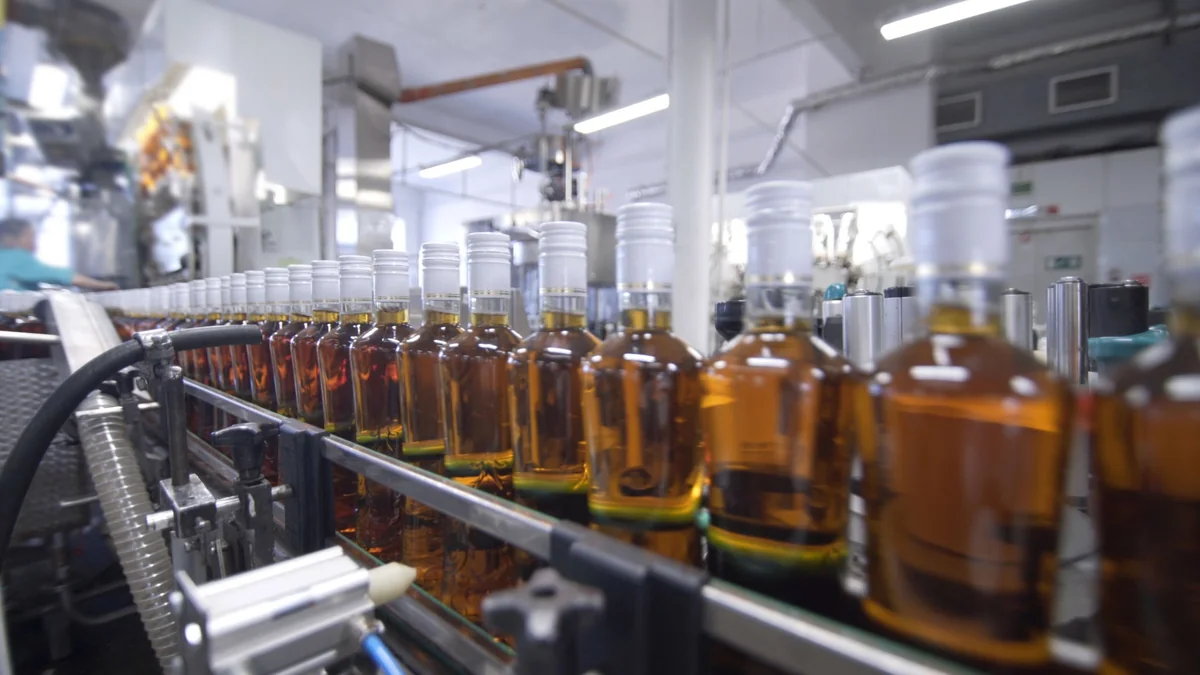
At the very end of the bottling line come processes that, to this day, stir strong feelings among connoisseurs.
What is chill-filtration?
Natural whisky contains plenty of fatty acids, esters and proteins. When such a whisky is chilled (e.g. with an ice cube) or diluted with water, these compounds precipitate, causing a cloudiness (so-called chill haze). To the mass-market consumer, cloudy spirit looks faulty, so most producers chill the whisky to about 0°C and force it under pressure through dense filters.
- Pro: the whisky is crystal clear and won't go cloudy with ice.
- Con: purists hate this method. Fatty acids and esters are carriers of flavour and of the
oily, rich texture (mouthfeel). Chill-filtration literally "slims down" the whisky.
The connoisseur's golden rule: if a whisky is 46% ABV or higher on the label and carries the note "Non-chill filtered", it means the producer has skipped this process, opting for full flavour and texture.
Caramel colouring (E150a)
Consumers subconsciously assume that the darker the whisky, the older and better it is (which is untrue). To even out colour differences between batches, the law permits adding a minimal amount of spirit caramel (E150a). Officially it doesn't change the flavour, but for many fans it destroys the drink's authenticity.
When the cork lands in the neck of the bottle, time stands still for the whisky — unlike wine, whisky no longer matures in the glass. Its decades-long journey from a small grain of barley to a noble elixir has just come to an end. It's your move.
Read on
This is the final step of the series The art of making whisky. You now know the whole road from grain to glass — now choose your bottle.
- ← Previous step: Maturation (ageing)
- 🥃 Browse the whisky catalogue and compare prices across more than a dozen shops.