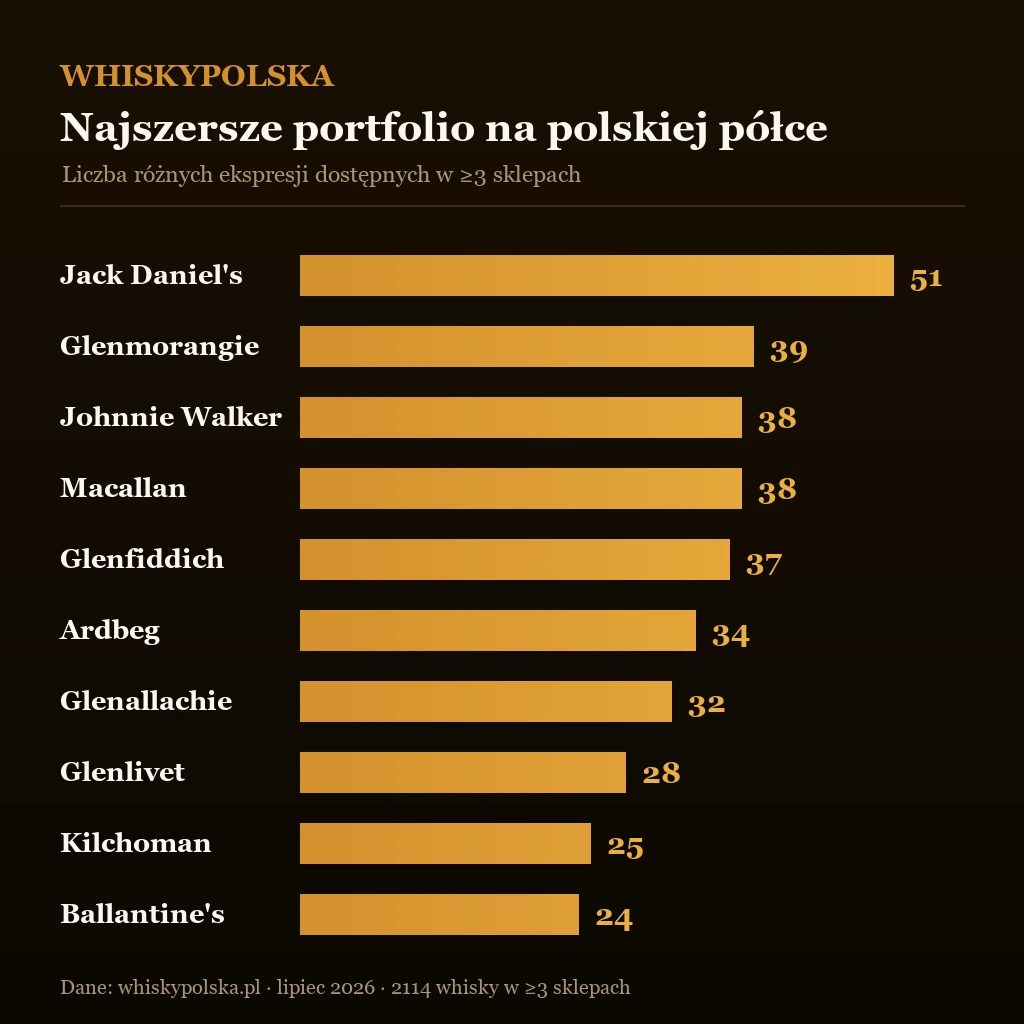
A "popular brand" is a phrase with two very different meanings — and they're easy to mix up. One brand is popular because it offers huge choice: dozens of different expressions, vintages and editions to pick from. Another is popular because it's everywhere — its core bottles stand in practically every shop, even if it has only a handful of variants. These are two completely different things, and lumping them together produces misleading rankings.
We set out to measure popularity so that it makes sense — no vibes, no guesswork. The key idea is simple: a brand is popular when every shop wants a piece of it on the shelf. Not one exotic cask at a single seller, but the core bottles — the ones an average customer reaches for — spread across the whole market. To that we add how broadly the brand is available and how recognisable it is. Three signals, one popularity index.
We focus on malt whisky — single malt and blended malt — because it's the heart of the category and what enthusiasts ask about most (bourbon, American whiskey and the big blends we leave for a separate analysis).
How we counted — the methodology
We start with the 3-shop threshold. A bottle hanging in a single shop isn't yet a market — it's a one-off offer, often a niche or a single batch. Only when the same product shows up at at least three different sellers are we talking about something you genuinely compare before buying and that shapes the Polish shelf. After filtering out single-shop offers and narrowing to malts, 1,150 whiskies remained — from close to 200 brands, listed across the 34 shops we monitor. This is a snapshot of the market as of 3 August 2026 (the range is alive, so the numbers drift slightly week to week).
Each brand's popularity index is built from three components:
- Core penetration (weight 50%) — in how many of the 34 shops you can buy **at least one of the
brand's five cheapest bottles. This is the heart of the idea: it measures how many places bothered to keep "a bit of that brand" in their basic range. We count 0.7 l bottles only** — no miniatures, otherwise the ranking would measure the availability of 50 ml samples rather than real bottles.
- Reach (weight 20%) — in how many shops any bottle of the brand stands. This rewards brands
that are widely available beyond the cheapest core, across different price tiers.
- Recognisability (weight 30%) — our 0–100 score for how established and known a brand is:
shop presence, production scale, the muscle of its owning group and reputation. It stops a global giant from losing to a distribution-savvy but little-known brand.
Two notes for good order. We group by the real brand name, not the database label — "The Macallan 18" and "Macallan 12 Sherry Oak" land together under Macallan rather than splitting into two bars. And we only count brands with at least 5 expressions on sale, so the ranking isn't skewed by one-off hits from outside the malt category.
The ranking: popularity index
Here are the twenty most popular malt whisky brands on the Polish market — sorted by our index. The columns show the components: penetration (out of 34 shops), reach (out of 34) and recognisability (0–100).
| # | Brand | Penetration | Reach | Recog. | Index |
|---|---|---|---|---|---|
| 1 | Glenfiddich | 27 | 29 | 90 | 83.8 |
| 2 | Talisker | 28 | 29 | 82 | 82.8 |
| 3 | Balvenie | 28 | 28 | 80 | 81.6 |
| 4 | Auchentoshan | 28 | 31 | 72 | 81.0 |
| 5 | Aberlour | 27 | 28 | 82 | 80.8 |
| 6 | Laphroaig | 27 | 27 | 82 | 80.2 |
| 7 | Glenlivet | 24 | 31 | 88 | 79.9 |
| 8 | Bowmore | 27 | 27 | 80 | 79.6 |
| 9 | Ardbeg | 26 | 29 | 80 | 79.3 |
| 10 | Macallan | 25 | 27 | 88 | 79.0 |
| 11 | Bruichladdich | 27 | 27 | 74 | 77.8 |
| 12 | Lagavulin | 25 | 25 | 82 | 76.1 |
| 13 | Dalmore | 25 | 25 | 78 | 74.9 |
| 14 | GlenDronach | 25 | 25 | 74 | 73.7 |
| 15 | Glenmorangie | 20 | 30 | 86 | 72.9 |
| 16 | Aberfeldy | 22 | 26 | 74 | 69.8 |
| 17 | Bushmills | 20 | 20 | 93 | 69.1 |
| 18 | Jura | 21 | 22 | 84 | 69.0 |
| 19 | Highland Park | 21 | 24 | 80 | 69.0 |
| 20 | Glen Moray | 22 | 24 | 71 | 67.8 |
Top of the list is Glenfiddich — and it's hard to find a better illustration of what this ranking is about. The world's best-selling single malt pairs a deep portfolio, record recognisability (90) and a core standing in 27 of 34 shops. Right behind it, the jump of the season: Talisker leaps to second on pure penetration (28 shops!) — the smoky Skye classic whose core "tens" have conquered Polish distribution. Rounding out the podium is Balvenie (penetration 28), with Auchentoshan right behind — an affordable Lowland workhorse with the widest reach in the whole ranking (31 shops).
The rest of the list holds no big surprises — and that's the point. Aberlour, Laphroaig, Glenlivet, Bowmore, Ardbeg, Macallan, Lagavulin — exactly the names an average enthusiast can rattle off from memory. A metric that pushes genuinely famous, ubiquitous brands to the top (rather than niche rarities available "somewhere out there") does precisely what we'd expect of it. One curious case is Glenmorangie (15th): the brand is almost everywhere (reach 30), but its cheapest core stands in fewer shops than its rivals' — so despite excellent recognisability it lands lower than intuition would suggest.
Two faces of choice: portfolio breadth isn't the same as popularity
It's worth showing why the sheer number of expressions is a poor measure of popularity. Below are the brands with the widest portfolio — how many different bottles of a brand you can actually buy (in at least 3 shops):
| # | Brand | Expressions | Avg shops per bottle |
|---|---|---|---|
| 1 | Glenfiddich | 30 | 8.4 |
| 2 | Glenmorangie | 28 | 8.1 |
| 3 | Macallan | 27 | 6.9 |
| 4 | Ardbeg | 23 | 9.9 |
| 5 | Glenallachie | 23 | 4.7 |
| 6 | Kavalan | 22 | 6.2 |
| 7 | Glenlivet | 21 | 6.8 |
| 8 | Jura | 19 | 7.2 |
| 9 | Kilchoman | 18 | 5.0 |
| 10 | The Singleton | 17 | 5.3 |
Look at Glenallachie (5th, 23 expressions) and Kavalan (22): on choice they beat many a giant, but their bottles stand in barely 5–6 shops on average — connoisseur favourites, a flood of single casks and cask-strength batches rather than "every shop" brands. That's why they land far lower in the popularity index: a deep portfolio ≠ ubiquity. The opposite case is Auchentoshan or Bowmore — a dozen-odd expressions, but the core is almost everywhere, so they sit near the top of the index. Our metric deliberately rewards the latter: the brand you'll actually run into when buying whisky in a random shop.
The bottles almost every shop carries
Let's drop from brands to individual bottles — the malts that stand in the largest number of shops. These are the most "default" single malts of the Polish market:
| # | Whisky | Shops |
|---|---|---|
| 1 | Glenfiddich 12 YO | 24 |
| 2 | Talisker 10 YO | 23 |
| 3 | Aberlour 12 YO | 22 |
| 4 | Balvenie Double Wood 12 YO | 22 |
| 5 | Lagavulin 16 YO | 22 |
| 6 | Macallan 12 YO Double Cask | 22 |
| 7 | Ardbeg Corryvreckan | 21 |
| 8 | Auchentoshan American Oak | 21 |
| 9 | Bowmore 12 YO | 21 |
| 10 | Glenfiddich 15 YO | 21 |
| 11 | Laphroaig 10 YO | 21 |
| 12 | Monkey Shoulder | 21 |
| 13 | Auchentoshan 18 YO | 20 |
| 14 | Dalmore 15 YO | 20 |
These are classics with no surprises — Glenfiddich 12, Talisker 10, Aberlour 12, Lagavulin 16, Laphroaig 10, Balvenie Double Wood. Icons that define the "standard shelf" of single malt. Good news for the buyer: since they stand in 20–24 shops, they're exactly where it's easiest to compare prices and catch the best deal.
Three archetypes of malt brands
Setting core penetration against portfolio breadth, Polish malt brands fall into three characteristic types.
Market pillars (high index — broad and everywhere) — big single malts that are both deep and ubiquitous: Glenfiddich, Talisker, Balvenie, Ardbeg, Macallan, Glenlivet. If you're after a "safe" brand with plenty of choice and reliable availability — this is it.
Connoisseur's paradise (deep but niche) — Glenallachie, Kavalan, Kilchoman, Arran, BenRiach, Loch Lomond. Loads of editions, single casks and batches — but each in fewer, often specialised shops. This is where you hunt for specifics.
Ubiquitous core (narrow but everywhere) — Auchentoshan, Bowmore, Aberfeldy, Glen Moray. A few positions, but genuinely everywhere. Perfect when you want a specific bottle and care about easy price comparison.
The malt landscape: single malt and Scotland
Quick context. What do these 1,150 malt whiskies consist of?
| Type | Whiskies | Share |
|---|---|---|
| single malt | 1,089 | 95% |
| blended malt | 61 | 5% |
| Country | Whiskies | Share |
|---|---|---|
| Scotland | 933 | 81% |
| Ireland | 57 | 5% |
| Japan | 36 | 3% |
| USA | 27 | 2% |
| Taiwan | 23 | 2% |
| India | 21 | 2% |
| England | 12 | 1% |
The picture is unambiguous: the world of malt whisky in Poland is above all Scottish single malt (95% of positions, 81% country share). Behind Scotland comes Ireland (Bushmills, Teeling), an ever-stronger Japan and — interestingly — a rising wave of American single malt (Balcones, Westward). Malt exotica — Taiwan (Kavalan!), India (Amrut, Paul John), England — is already genuinely present, though still niche.
What it means for the buyer
Three practical takeaways:
- Want a sure, well-known brand you can price-compare anywhere? Head to the top of the index —
Glenfiddich, Talisker, Balvenie, Auchentoshan. Their core stands in most shops, so you've got choice and plenty of places to hunt for the best price.
- After a specific, "banker" bottle? The classics from the ubiquitous-bottles list (Glenfiddich 12,
Talisker 10, Lagavulin 16) are almost everywhere — and the more shops, the wider the price spread and the more there is to save.
- Hunting rarities? The connoisseur's paradise — Glenallachie, Kavalan, Kilchoman — offers depth of
editions and single casks, but be ready to search in specialised shops.
You can filter all 1,150 malt whiskies (and everything else) by brand, country, type and price in our catalogue, and we gather the best current offers in the deals section. And if you're curious where these bottles come out cheapest — check our ranking of the most cost-effective shops.
August shop roundup
If you want to drop from brands down to shops — where these single malts actually come out cheapest — see our August roundup of Polish whisky e-shops: a ranking scored with a shared single-malt basket (plus liqueurs and bourbons), with a dedicated section for smaller shops beyond the market giants.
Data: whiskypolska.pl, as of 3 August 2026, malt whiskies (single malt and blended malt) stocked in ≥3 of 34 monitored shops. Popularity index = 0.5·core penetration + 0.2·reach + 0.3·recognisability.